Derui chamber


 Message
ELECTRIC MOTORCYCLE BATTERY PACKS · PRODUCTION RELEASE CHECKS
A battery pack can power on and still need further checks before release. A useful end-of-line test sequence links the pack identity to defined electrical measurements, communication responses and a documented pass/fail decision.
Build the release check around your pack
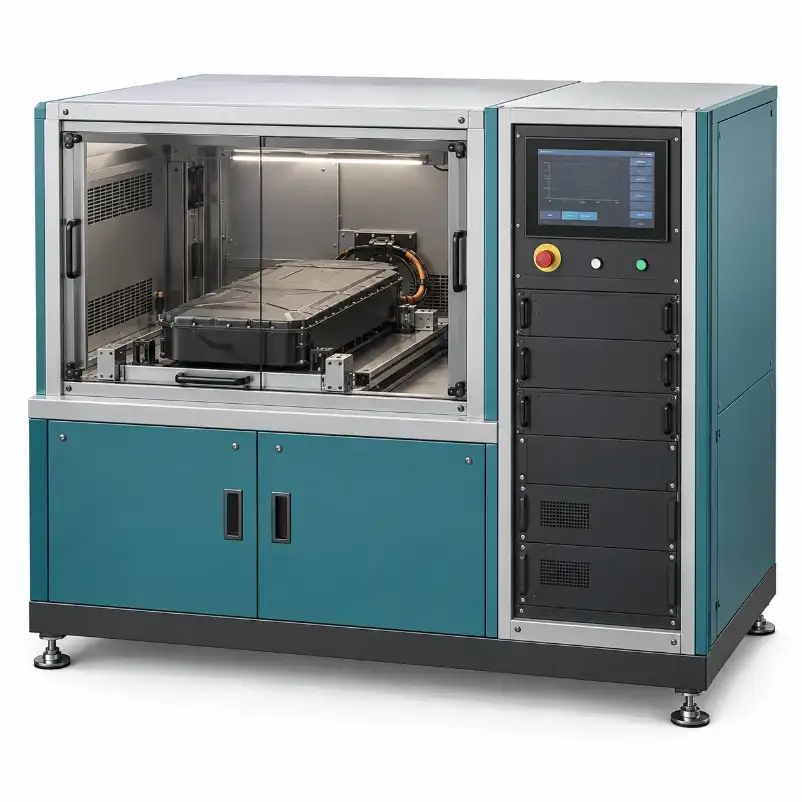
Derui’s electric motorcycle battery pack EOL test bench is presented as a project-configured inspection solution. Start with your pack specification and release checklist, then agree on the instruments, connector tooling and sequence. The selected checks—not the cabinet appearance—define what the system can verify.
Choose EOL Coverage Before Choosing Instruments
For pack manufacturers and vehicle OEMs, the first question is which defects the release station must screen for. The matrix below is a scope-planning checklist, not a statement that every test is standard equipment.
| Inspection objective | Define with your team | Required evidence |
|---|---|---|
| Identity and interface | Pack variant, connector pinout, polarity and permitted connection sequence. | Correct recipe, connection status and serial-number association. |
| Electrical release checks | Open-circuit voltage and any approved current pulse or functional load. | Measured values, conditions, limits and instrument identification. |
| BMS communication | Wake-up, messages, scaling, firmware variants and accessible diagnostic states. | Expected responses and a defined communication timeout decision. |
| Insulation / withstand testing | Applicability, test points and the pack manufacturer’s approved method. | Compatible instrument, verified contact path and controlled test sequence. |
| Release record | Result format, reject route, access control and retest policy. | Pack-specific record rather than only a green indicator. |
Make the Pack Connection Repeatable
Share pack dimensions, mass, connector drawings and any handling restrictions. The fixture must locate the pack without damaging the enclosure or connectors and accommodate the actual connector mating sequence. Specify manual or assisted loading, changeover needs and access for maintenance.
The power connection, sense wiring and communication harness have different jobs. Agree on contact verification, routing, strain relief and wear-part replacement. A disconnected measurement lead must not be mistaken for a healthy pack. Where a resistance measurement needs separate sense contacts, identify the sensing points rather than assuming fixture lead resistance is negligible.
Different packs may use contactors, semiconductor switches or other output arrangements. Provide the actual schematic and BMS behaviour; do not assume every motorcycle pack has the same pre-charge circuit or an accessible service interlock.
Keep Measurements and Conclusions Separate
Instrument vs BMS value
A reported BMS voltage or current is not automatically an independent measurement. Define the reference instrument and comparison method when accuracy is part of acceptance.
ACIR vs pulse DCIR
These are different methods. Define the stimulus, timing, state of charge, temperature and measurement boundary before comparing results.
Short check vs capacity
A brief operating pulse can support a release check but does not establish full capacity, cycle life or remaining service life.
Charge/discharge testing requires a voltage, current, power and time envelope. These maxima are not necessarily available simultaneously. Ask which conditions are continuous, how energy is dissipated or returned, and what cooling and facility provisions are required. Regenerative operation and its efficiency must be specified for the selected power hardware, not inferred from an EOL label.
BMS integration also needs more than a protocol name. Supply the message definition or approved interface, identifiers, scaling, timing, wake/sleep conditions and authentication requirements. Reading available pack messages does not prove support for all cell-level data, firmware flashing or fault injection.
A Defined Path from Loading to Release
Select the recipe
Associate the pack identity with the approved variant and revision of the test plan.
Verify readiness
Confirm fixture state and the required connection checks before the approved sequence begins.
Run the sequence
Perform only the agreed checks, retaining values, limits and any interrupted or invalid results.
Record and route
Complete the engineered safe-state sequence, save the result and route failed packs for controlled review.
Configuration Details to Put in the Quotation
- Pack envelope: minimum and maximum operating voltage, charge state, allowable current, pulse duration and connector ratings.
- Test resources: instrument functions and ranges, measurement uncertainty, switching paths and calibration responsibilities.
- Fixture: pack handling, connector life, contact checks, model changeover and replacement harnesses.
- Data: recipe version, measured values, units, limits, fault codes, operator and serial number. Define file export or factory-system interface separately.
- Line operation: load/unload time, full sequence time, changeover, availability target and rejected-pack procedure.
- Site and risk controls: supply, earthing, isolation, access control, residual-energy handling and the site’s battery incident plan.
Multiple channels need a clear allocation of instruments and power capacity. Shared measurement or power resources can constrain simultaneous testing. Include the planned concurrent workload in the acceptance trial.
A routine release sequence does not replace transport, abuse, environmental or full life testing. Destructive short-circuit or thermal-runaway experiments are not assumed functions of this station. Protective covers and an emergency stop do not establish battery fire containment.
Accept the Station with Representative Packs
Use an approved sample set and a signed sequence during factory acceptance. Verify fixture repeatability, reference measurements at relevant operating points, message handling, timeout behaviour and traceable pass/fail records. Use approved reference devices or controlled fault simulations to test reject logic; do not create hazardous pack faults for a demonstration.
Demonstrate the full sequence at the required concurrent load. Include data-transfer interruptions, invalid identification, duplicate tests and an approved recovery procedure. Safety functions and residual-energy handling need their own engineering verification, not just a successful software screenshot.
Send these items for a useful proposal
Provide the pack drawing, electrical specification, pinout, BMS interface, required release checks and limits, target takt, pack variants, factory data requirements and installation conditions. Sensitive documents can be shared through an agreed channel after initial contact.
Battery Pack EOL Test Bench FAQs
Does a short EOL test measure battery capacity?
Not by itself. Capacity needs an agreed charge/discharge method and conditions. Keep that requirement separate from the short production release sequence.
Can the bench communicate with our BMS?
Compatibility depends on the actual interface, messages, access rules and implementation. Supply the protocol definition and representative pack for an integration review.
Are insulation and withstand tests always included?
No. Their applicability, compatible instruments, connection points and approved test method must be specified. They are not interchangeable checks.
Can multiple pack variants share one station?
Review fixture changeover, harness identification, instrument envelope and recipe control for each variant. Similar enclosures do not prove electrical compatibility.
Does a pass result certify the battery?
It means the agreed release sequence passed under recorded conditions. It is not a substitute for the product’s required qualification and certification programme.
What determines the test time?
Connection, settling, communication, electrical test duration, safe-state handling and record transfer all contribute. Quote the complete cycle rather than instrument measurement time alone.
Define the Checks That Matter Before Shipment
Start with the battery pack and release requirements. Agree on the fixture, instruments, sequence and acceptance evidence before choosing the station configuration.