Derui chamber


 Message
MOTORCYCLE TESTING EQUIPMENT · FRAME DURABILITY
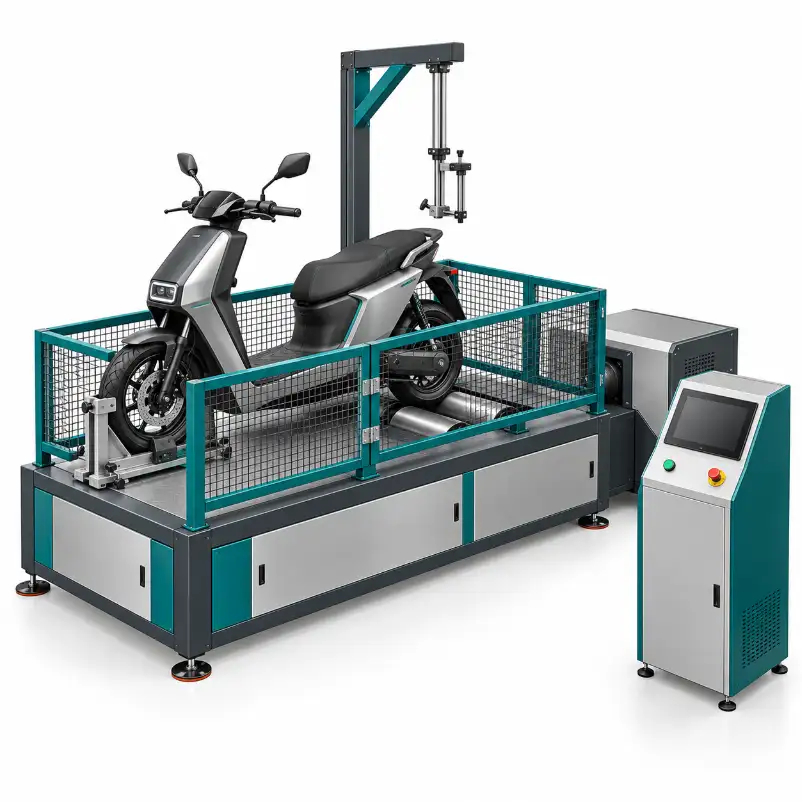
Discuss a motorcycle frame vibration test machine around the frame you need to evaluate, its mounting conditions and the repeated loading defined by your test method. Send Derui your frame drawings and test brief so the fixture, loading arrangement, controls and measurement requirements can be reviewed together.
A useful equipment proposal identifies how the frame is supported, where the load is applied, what is controlled and which results must be recorded. The required force, displacement and frequency must be considered together for the proposed specimen and fixture.
Define the Frame Test Scope
Frame manufacturers, component suppliers and development laboratories may need to compare design revisions or evaluate a frame under a specified repeated load. Before selecting equipment, define whether the specimen is a bare frame, a frame with selected components or a more complete assembly. Those choices affect the mounting interfaces, mass distribution and clearance needed around the test area.
Identify the purpose of the test: for example, checking a specified loading programme or investigating a particular mounting region. A frame durability rig, a vehicle chassis dynamometer and a wheel fatigue machine perform different tasks. Use our motorcycle test bench selection guide if the required equipment family is still unclear.
Motorcycle Frame Test Machine Configuration
Use the following requirements to define the proposed system. The table is a configuration checklist; numerical capacities and included functions must be confirmed in the model-specific quotation.
| Configuration item | Information to review | What to confirm in the proposal |
|---|---|---|
| Specimen and working space | Frame dimensions, mass, installed components and handling access. | Working envelope, installation clearance and handling arrangement. |
| Mounting and fixtures | Mounting coordinates, interface sizes, supported points and permitted movement. | Fixture layout, adapters, alignment and responsibility for sample-specific tooling. |
| Loading arrangement | Application point, direction, waveform and required load or motion. | Loading direction, actuator arrangement and achievable operating range for the proposed setup. |
| Force, displacement and frequency | Required operating points, stroke or amplitude, cycle count and intended duty. | Compatible operating conditions rather than unrelated maximum ratings. |
| Control and measurement | Controlled variable, measured signals, sensor locations and required tolerances. | Control functions, sensor ranges, channels, recording and verification scope. |
| Site and utilities | Installation location, available power, floor conditions and access. | Equipment footprint, utilities and any site preparation included or required. |
Different frame geometries may require different adapters or a revised fixture. Include drawings for every specimen family you want to test. Multi-axis loading, resonance measurement and road-signal reproduction should each be specified and reviewed as separate requirements.
Agree on Controls, Measurement and Test Records
Control the required variable
State whether the method calls for force, displacement or another controlled quantity. Provide the loading sequence, operating limits and required stopping conditions.
Record the required evidence
Identify the signals, units, sensor locations, cycle records and export format needed by your laboratory. Ask to review a sample output for the proposed software configuration.
Define protection and inspection
Agree on guarding, emergency stop, overload and travel protection, as applicable to the equipment. Define inspection intervals and how observations or specimen damage will be recorded.
If strain, acceleration or other additional measurements are required, specify them in the enquiry. Data recording does not by itself establish automatic crack detection. Define the inspection or detection method separately.
Match the Equipment to Your Approved Test Method
Provide the applicable standard, customer specification or internal test procedure, including its edition and relevant clauses. The method should identify specimen preparation, mounting, loading, inspection and acceptance criteria. Equipment suitability can then be reviewed against that defined scope.
The ISO 5349 series concerns human exposure to hand-transmitted vibration, while ISO 2631 concerns human exposure to whole-body vibration. Those references alone do not establish a motorcycle frame fatigue test specification or certify this machine. If rider vibration is part of your project, identify it as a separate measurement objective. See the ISO catalogue for vibration and shock with respect to human beings.
State the frame acceptance criteria before testing. A completed cycle count, an inspection result and a product approval decision are different records; agree which evidence the proposed equipment must produce.
Confirm the Supply and Acceptance Scope
Ask for a proposal that distinguishes included equipment, specimen-specific fixtures, optional functions and work to be supplied by your laboratory. This makes quotations easier to compare and helps resolve missing inputs before manufacture.
- Equipment and tooling: identify the machine configuration, adapters, sensors, control hardware and software included.
- Acceptance demonstration: agree on the specimen or substitute, operating conditions, checks, records and acceptance criteria for the factory trial.
- Documentation: specify manuals, configuration drawings, test records and calibration or verification documents required for the quoted scope.
- Delivery and support: confirm packing, installation responsibilities, training, warranty terms and support arrangements in the quotation.
What to Send for a Motorcycle Frame Test Equipment Quote
- Frame drawings and photographs: include overall dimensions, mass, mounting interfaces and any components installed during the test.
- Test method: share the procedure or relevant clauses, loading direction and application points.
- Operating requirements: identify required force or motion, frequency, waveform, cycle count and duty. Mark values still under review.
- Measurement and acceptance: list controlled and measured quantities, inspection needs, required data outputs and acceptance criteria.
- Project conditions: provide the installation country, available utilities, project stage and required delivery timing.
If drawings or methods are confidential, contact Derui to agree how to share them. The custom test machine RFQ checklist provides a broader preparation guide.
Questions Before Selecting a Frame Vibration Test Machine
Can one fixture cover several frame sizes?
Compatibility depends on geometry, mounting interfaces and the load path. Send drawings for all intended specimens so adapter changes and adjustment requirements can be identified in the proposal.
How should I compare frequency ratings?
Compare the required frequency at the specified load, motion amplitude and specimen setup. Ask for confirmation of those operating points; a maximum frequency alone does not define the usable test envelope.
Can the equipment reproduce recorded road data?
Road-data reproduction requires review of the input signal, loading arrangement, controller and measurement system. Include the required signals and objectives in the enquiry so suitability can be assessed for the proposed configuration.
What determines test duration?
The loading programme, cycle count, frequency, pauses and inspection intervals determine duration. Confirm the test sequence before estimating run time or laboratory capacity.