Derui chamber


 Message
ONE COMPLETE SCOOTER · TWO ROAD-CONTACT ROLLERS
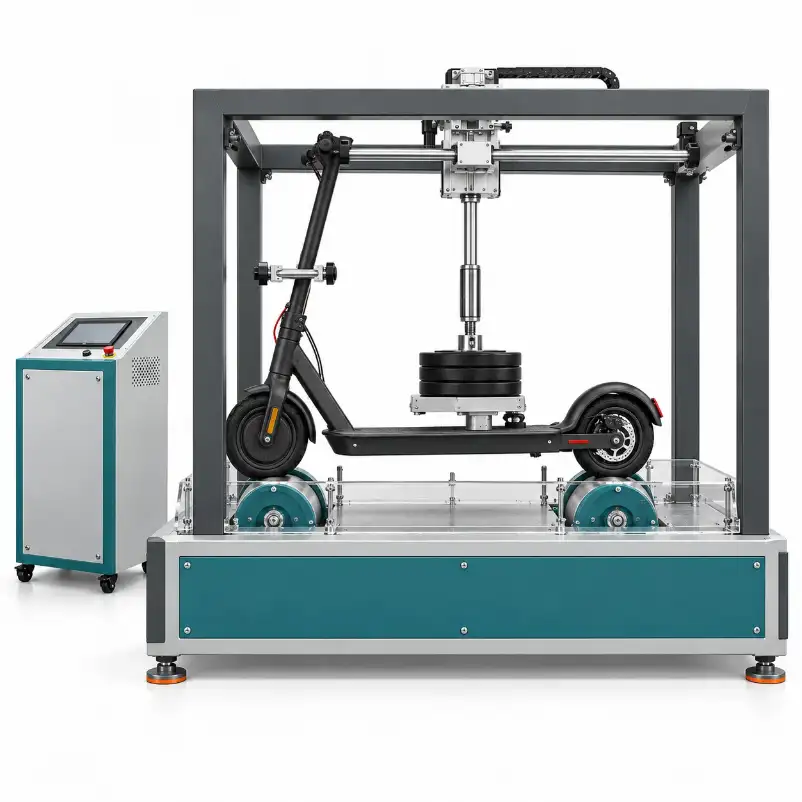
The deck, stem, joints and wheel attachments share the loads on an assembled scooter. A double-roller test arrangement keeps the front and rear wheel contacts in one setup so that a defined cyclic programme can be applied to the complete specimen.
Define the load path before the endurance run
Derui’s double-roller scooter test machine is a starting point for complete-scooter durability work. Review front/rear wheel support, deck loading and restraint geometry together. Here, double roller describes the wheel-contact arrangement—not two independent scooter stations.
When to Choose a Complete-Scooter Roller Test
This arrangement suits a project where the approved method requires the scooter to remain assembled while both wheels experience rolling exposure. R&D teams can investigate a design revision; quality teams can compare representative builds under a fixed programme. The result remains tied to that fixture, loading and exposure.
Observe interacting parts
Inspect the deck, stem, joints, wheels and attachments at the specified intervals rather than isolating a single tire.
Preserve the intended path
Agree where the load enters the deck and what movement the restraints permit.
Control the exposure
Use documented drum conditions and endpoints so results from different specimens are interpretable.
For a quick operating check on every production unit, a run-in rack may be more appropriate. For tire-specific comparisons, use a wheel-focused test method. These tasks should not be described as interchangeable.
Fit Both Wheel Contacts Without Over-Constraining the Scooter
Supply wheelbase, tire diameters and widths, deck height/shape, stem geometry and any protruding parts. Review the actual adjustable range and clearance of the proposed machine. A rendering of one scooter cannot establish compatibility with all wheelbases or tire types.
Specify the rider-equivalent loading points and distribution required by your method. A weight stack, a pneumatic actuator and a closed-loop force system do not apply identical dynamic loads. If force regulation or measurement is required, identify its location and working behaviour.
The stem restraint should provide the approved stability without unintentionally bypassing the structure under evaluation. Define allowed vertical motion, pitch and steering movement. Check that fixtures, cables or load saddles do not reinforce the deck or folding joint and hide a failure mode.
Choose the electrical state of the scooter
Externally driven road drums can expose a specimen differently from a scooter driving under its own motor power. For powered running, agree on throttle control, battery preparation, driven-wheel layout, controller behaviour and thermal provisions. Do not assume a mechanically driven drum provides calibrated road load or a chassis power measurement.
Specify the Front-to-Rear Drum Programme
Record drum diameter, contact surface and roller spacing. If obstacles are part of the method, define their profile, height, number and mounting. Also define the relative timing of front and rear events; two nominally identical drums can expose the assembly differently depending on their phase relationship.
Identify whether speed is shaft speed or surface speed and how it is measured. Define the working speed and loading conditions together. A distance display based on drum rotation is an exposure calculation; tire slip and contact geometry must be considered before comparing it with road travel.
A complete programme also states its time or event endpoint, inspection pauses and restart rules. Drum revolutions, obstacle contacts and scooter-wheel revolutions are not the same count. A machine with a timer alone cannot automatically report all three.
A defined drum programme does not automatically reproduce cornering, loose gravel, wet grip, slope resistance or an outdoor service lifetime. Those conclusions need the relevant additional method and evidence.
Link Running Exposure to Physical Inspection
The useful result is more than “test completed.” Agree on initial inspection, intermediate checks and final criteria for cracks, permanent change, fastener loosening, wheel attachment, steering/folding function and other items within your method.
Record the scooter identity, build revision, tire preparation, load fixture, drum recipe, exposure and every interruption. If strain, acceleration, temperature or reaction force is needed, specify the sensor location, range and data capture. Motor current or a cycle counter is not a substitute for these measurements.
Retain photographs and inspection findings with the run record. A stopped test should distinguish specimen failure, a safety intervention and a machine fault; combining them all into one red indicator makes later comparison difficult.
From Scooter Installation to an Endurance Record
Document the build
Record the assembly state and baseline inspection required by the method.
Set contact and loading
Verify both tire contacts, load saddle, restraints and available movement.
Run the drum recipe
Use the agreed electrical state, speed, obstacles and inspection pauses.
Apply the endpoint rules
Associate the exposure, observed condition and result with the individual specimen.
Configuration and Factory Acceptance
| Selection item | Define in the technical scope |
|---|---|
| Scooter fit | Wheelbase, tire envelope, deck loading region and fixture clearances. |
| Drum system | Geometry, working surface speed, drive arrangement and obstacle timing. |
| Loading / restraint | Load magnitude and path, permitted motion and proof against fixture slip. |
| Measurement | Measured vs calculated channels, counting basis, sampling and calibration. |
| Protection | Moving contacts, fragment hazards, loading hardware, access and stop functions. |
| Delivery | Representative acceptance run, records, utilities, foundation requirements and maintenance. |
Accept the machine using a representative scooter under the proposed working load. Verify alignment throughout travel, drum speed and timing, fixture behaviour, counting and stop/recovery functions. Include sample records so the test team knows which values are actually retained.
If you need a named standard, identify the scooter’s product category and exact method first. Human-powered kick-scooter and electrically powered vehicle requirements have different scopes. A roller test supports only the agreed part of an evaluation; it is not a full-market certification.
Send a focused RFQ
Provide the scooter drawing, test method and version, loading points, desired drum/obstacle programme, electrical state, inspection criteria, required records and installation constraints.
Double-Roller Scooter Tester FAQs
Does double roller mean two scooters can be tested?
No. In this arrangement the two rollers support the front and rear wheels of one scooter. Multiple specimen stations would be a separate configuration.
Can it test both electric and non-powered scooters?
Review mounting, drive mode and the approved method for each. Mechanical fit does not establish electrical or regulatory compatibility.
Does it measure motor power or climbing performance?
Not automatically. Those tasks require a defined loading and measurement system beyond basic drum rotation.
Can we change the wheelbase or obstacles?
Put the required range and obstacle details into the quotation. Adjustable spacing does not imply every roller diameter or road surface is changeable.
Is the roller distance the same as actual road mileage?
It describes the agreed laboratory exposure. Road-life equivalence needs separate correlation and cannot be assumed from the display.
Which standard does the machine satisfy?
Compatibility must be assessed against the applicable product category, edition and test clause, including fixture, loading, speed and inspection requirements.
Make the Whole-Scooter Test Reproducible
Review both wheel contacts, the deck load path and the drum programme before selecting the equipment.