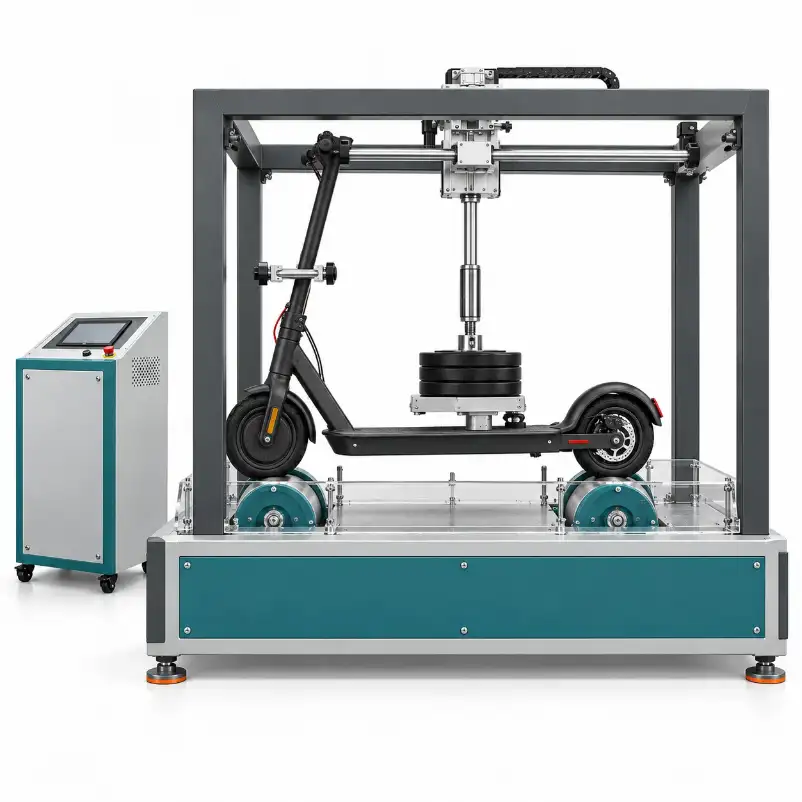
Derui chamber


 Message
SCOOTER TEST EQUIPMENT · DROP-IMPACT EVALUATION
Assess a scooter assembly after a defined drop-impact event. Derui’s scooter drop test machine is intended for laboratory projects where the specimen, lifting arrangement, release condition and landing surface must be specified together—not selected from a drop-height number alone.
Define the drop your scooter must withstand
The reference arrangement is a vertical test tower with a surrounding mesh enclosure and internal guides. Review the actual specimen and procedure to determine the lifting interface, permitted restraint and impact conditions for the proposed configuration.
- What falls? The scooter, a specified assembly or a defined moving test fixture.
- How does it land? Required attitude, first contact, surface and any remaining restraint.
- What is assessed? Structural condition, function and any specified measured response.
Drop-Impact Testing for Scooter Assembly Decisions
A defined drop test can reveal damage or functional change that a visual inspection before testing would not show. Decide which assembly and failure criteria matter to your project before choosing the equipment.
Compare design revisions
Compare wheel, fork, deck or structural-joint revisions under the same specified impact conditions.
Locate post-impact change
Record cracks, deformation, loosening, wheel damage or loss of function at defined inspection points.
Reproduce the required event
Match preparation, release, landing attitude and inspections to a controlled test procedure.
These are assessment objectives, not a claim that every component or scooter type fits the same fixture. This page concerns the scooter or specified assembly, not its shipping carton. Package-handling tests and long-duration roller endurance have different test boundaries.
A Scooter Drop Is Not the Same as a Falling-Weight Impact
| Arrangement | What moves? | What to confirm |
|---|---|---|
| Released specimen | The scooter or assembly is lifted, then released toward the specified surface. | How the lifting connection disengages, the intended attitude and freedom during the fall. |
| Guided drop assembly | A defined moving assembly remains subject to guide or fixture constraints. | Moving mass, permitted constraint, guide influence and the resulting contact condition. |
| Falling-mass impact | An impactor falls onto a supported specimen. | Impactor geometry, mass, specimen support and measurement scope; a different equipment task. |
Vertical guide columns may position a lifting mechanism without guiding the specimen after release—or may remain part of the moving assembly. The tower image alone does not establish which arrangement is supplied.
Provide the required method before requesting a configuration. A setup for a wheel-first landing may not support a horizontal attitude, side impact or another orientation. Confirm each requested task rather than treating “multi-function impact testing” as a complete specification.
Specimen Fit, Height Reference and Landing Conditions
Define the installed specimen
Supply scooter length, width, height, mass, wheelbase and the adjustment positions used for testing. Identify whether batteries, accessories, test masses or a specific assembly are included. Review the usable test space and access with that configuration—not just the empty enclosure dimensions.
The lifting interface must hold the specimen as intended before release without damaging it or bypassing an interface being assessed. If a fixture remains attached during impact, define its mass and constraints as part of the test.
Measure the relevant drop height
Identify the reference point and impact surface in the procedure. A carriage-position display is not automatically the clearance of the intended first-contact point. Scooter attitude, tyre shape, attached fixtures and the surface height affect the relationship.
Where the procedure specifies a level landing or a particular wheel contacting first, verify the relevant wheel clearances and attitude. Agree on how the release is checked for unintended rotation, sideways movement or continued support.
Specify the landing surface and rebound treatment
Define surface material, geometry, support and condition. Review whether it is part of the machine base or a separate installation. A protective mat, damaged surface or flexible support can change the event and should not be added without method approval.
Decide how rebound and secondary contact are handled and recorded. A lift command, release command and actual impact are different events; the counting logic and any impact confirmation must match the required procedure.
What to Record Before and After Impact
Agree on observations, measurements and permitted interventions before testing. Keep the equipment operation record separate from the specimen acceptance decision.
- Before the test: assembly revision, specimen mass/configuration, adjustment and tightening conditions, tyre preparation and initial observations.
- Setup: lifting/support interface, attitude, height reference, impact surface and any attached test mass or fixture.
- Event history: valid drops, interruptions, abnormal releases, secondary contacts and any repositioning.
- After the event: specified checks for cracks, deformation, joint security, wheel or tyre damage and functional change.
- Assessment: result against the stated criteria, with photographs and the required measurements.
If the programme repeats impacts on one specimen, define inspection intervals and what happens after a suspected failure. Do not reset, repair or retighten the specimen between drops unless the method permits it and the intervention is recorded.
Impact measurement is a separate configuration
A height setting and counter do not provide an impact-force curve. Force, acceleration, displacement, velocity, high-speed imaging or automatic damage detection require appropriate hardware, acquisition and verification. Specify the required output and ask for a representative record.
Drop height alone does not define peak impact force. The moving assembly, contact geometry and deformation affect the response. Do not present a calculated energy value as a measured force or as proof of complete-vehicle safety.
Scooter Drop Tester Configuration Checklist
Use this checklist to compare equipment proposals on the same basis. Rated values must be confirmed for the offered model and installed specimen.
| Area | Inputs to provide | Confirm in the proposal |
|---|---|---|
| Specimen & space | Dimensions, mass, configuration and required test attitude. | Usable envelope, access, positioning and fixture compatibility. |
| Lifting & release | Permitted support, attachment and freedom after release. | Included interface, release arrangement, moving mass and verification method. |
| Height setting | Required range, reference point and acceptance tolerance. | Usable range with the actual sample, readout reference and verification. |
| Impact surface | Method, surface specification and first-contact requirement. | Included plate/base, support requirements and replacement criteria. |
| Sequence & evidence | Drop count, inspection points, stop rules and records. | Completion logic, interruption handling and installed measurement/export functions. |
| Protection & installation | Site access, utilities, handling and laboratory risk controls. | Guards, access control, raised-load protection, installation and training scope. |
Confirm total lifted mass separately from specimen mass, and distinguish the usable drop-height range from overall tower height or carriage travel. Ask which fixtures, surfaces, verification documents and spare wear parts are included. Additional orientations or test tasks require separate review.
Select the Applicable Scooter Standard and Exact Test Task
EN 17128 addresses personal light electric vehicles within its scope. EN 14619 and ASTM F2264 concern non-powered scooters within their respective scopes. These are not interchangeable whole-vehicle compliance labels.
Provide the target market, product classification, standard edition and exact test method. Check specimen preparation, load or mass, release condition, impact attitude, surface, number of events and assessment against that method. A laboratory internal procedure also needs these conditions defined.
The proposed setup must be reviewed for the specified task. Passing that task does not establish every mechanical, electrical or other requirement, nor does buying a machine establish laboratory accreditation.
A defined impact programme is also not a complete crash reconstruction or a direct prediction of years of service. Report the tested conditions and observed results without extending them beyond the evidence.
From Test Procedure to a Demonstrated Drop Setup
Specify the event
Identify what falls, the required attitude, surface and assessment criteria.
Review the specimen
Check installation, lifting interface, height reference and release clearance.
Demonstrate the sequence
Confirm release, first contact, valid-event counting and required records.
Inspect and document
Review post-impact changes against the procedure and retain the evidence.
Equipment Acceptance and Operator Protection
Use a representative specimen and an agreed demonstration plan to check installation, the usable height range, release and landing behaviour. Confirm the actual supplied functions before equipment acceptance.
- Geometry: demonstrate sample fit, attitude and the chosen height reference.
- Operation: show the agreed release and contact conditions, completion logic, interruptions and restart procedure.
- Evidence: review setup records, verification documents, output examples and any installed measurement channels.
- Handover: confirm operating limits, fixture instructions, inspection/maintenance needs and training.
Review raised loads, unintended release, crush points, specimen rebound and fragment containment. A mesh enclosure’s appearance does not establish its containment capability, access interlocks or safe raised-load support. Confirm these functions in the technical design and supplied instructions.
Battery-equipped specimens require an appropriate laboratory risk assessment, operating state and response plan. The mesh cage shown is not evidence of fire or thermal-runaway containment. Follow the laboratory’s procedure before any post-impact energisation or functional check.
For repeated rolling exposure rather than discrete drops, review the scooter dynamic durability roller tester. For a folding joint’s repeated operation, review the folding mechanism fatigue test configuration.
What to Send for a Scooter Drop Test Machine Quote
- Specimen: drawing, photographs, dimensions, mass and test configuration.
- Method: procedure or standard edition/clause, release arrangement and landing attitude.
- Conditions: height reference/range, any added mass, impact surface and required event sequence.
- Evidence: inspections, measurements, valid-event definition and records.
- Installation: site space, handling, utilities, protection and equipment acceptance requirements.
Get a proposal built around the actual drop event
Send the sample information and required procedure. Derui can review the fixture, release, landing and recording scope so your team can compare what is included.
Scooter Drop Tester Buying Questions
Does this drop the scooter or a weight onto the scooter?
The page concerns scooter or assembly drop-test projects. A falling-weight impactor is a different arrangement. Confirm the moving specimen, any attached fixture and the release design in the proposal.
Is it a pure free-fall test?
That must be demonstrated for the required configuration. Visible guide columns do not establish whether the specimen is fully released or remains constrained. Define permitted contact and restraint during the event.
Can both wheels land together or one wheel land first?
These are different attitude and contact requirements. Provide the exact procedure and review whether the fixture, clearance and release support it; do not assume both are standard functions.
What drop height and mass capacity are available?
Request model-specific values for your sample, fixture and attitude. Usable height is not overall tower height, and total lifted mass may include more than the scooter itself.
Does it automatically record impact force or detect cracks?
Not from a height display or cycle counter alone. Confirm the installed sensors, acquisition and evaluation functions, and ask for an example record if these outputs are required.
Does the enclosure make every battery-impact test safe?
No. Guard containment, access control and battery-related hazards require separate assessment. A mesh guard is not evidence of fire containment or a validated battery test facility.
Does the test establish EN 17128 compliance?
A matched setup can address an agreed task within an applicable programme. A single drop test does not establish every requirement of the complete-vehicle standard or laboratory accreditation.
What determines the equipment price?
Specimen dimensions and mass, usable height, lifting/release fixtures, landing surface, sequence, measurements, safeguards and acceptance scope determine the configuration.