Derui chamber


 Message
SUSPENSION ENDURANCE · FRONT FORK & SHOCK ABSORBER COMPONENTS
Repeated suspension movement can reveal leakage, wear, looseness or changes in operation. A useful endurance test controls the mounting and cycling conditions so that the findings can be compared—not simply the final cycle count.
Plan two specimen positions around one clear test objective
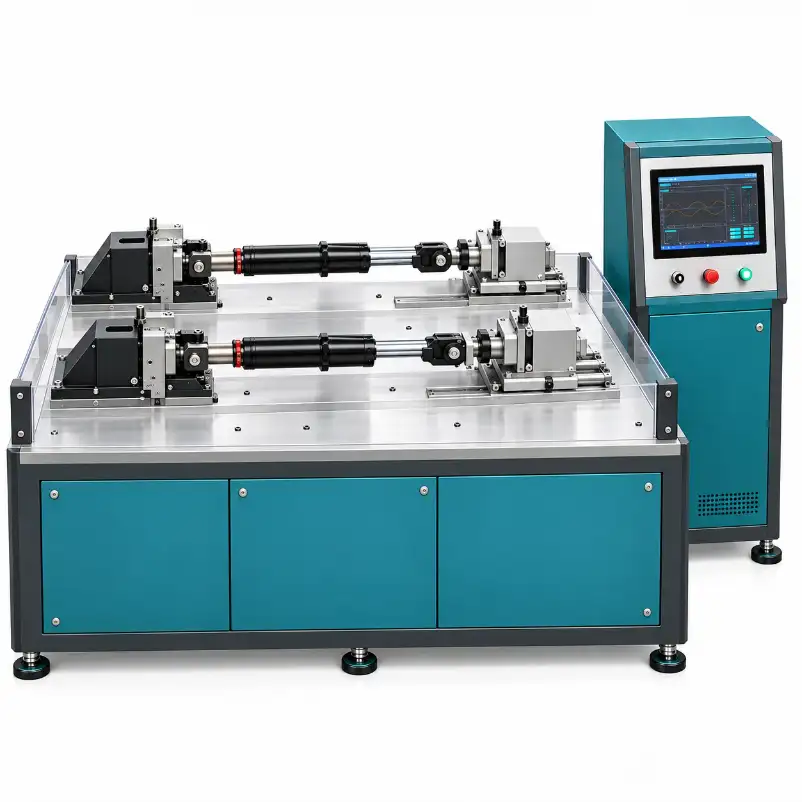
Derui’s dual-station front fork shock absorber durability tester provides a starting point for reviewing two-position suspension endurance work. The reference arrangement uses horizontal specimen locations. Confirm the actual fixture, drive architecture and measurement scope for your components.
Endurance, Damping Characterisation or Production Screening?
Suspension suppliers, vehicle development teams and quality laboratories need different evidence. Select the main task before specifying instrumentation.
| Task | Main question | Scope to agree |
|---|---|---|
| Cyclic endurance | How does the part behave after defined repeated movement? | Mounting, travel, frequency, temperature, duration and inspections. |
| Damping characterisation | What is the force response at defined displacement and velocity? | Calibrated force/motion channels, synchronization and analysis method. |
| Short production check | Does an assembled part meet a bounded release condition? | Short recipe, limits, cycle time and traceable pass/fail decision. |
A durability machine does not automatically include a damper dynamometer, an assembly press or a high-speed EOL inspection system. Request each function explicitly if your project needs it.
Fixture Fit Comes Before the Load Rating
Send a drawing that identifies whether the specimen is an individual damper, fork leg, cartridge or complete fork assembly. Include mounting interfaces, permitted clamping areas, installed length, available travel and the required orientation. A fixture suited to an eye-ended damper does not automatically fit a full fork crown, axle and steerer assembly.
Define the axial load path and any permitted angular freedom. Misalignment or an overly constrained mount can introduce side loads and change the result. A horizontal setup may also behave differently from the installed orientation of a fluid-filled part; have the component engineer approve the arrangement and preparation method.
If a test needs bending, lateral loading or a full-fork structural fatigue arrangement, review a dedicated fixture and actuator scheme. Do not assume axial cycling of an individual suspension component covers those tasks.
Specify Travel, Frequency and Temperature Together
State the minimum and maximum specimen length during cycling, preload, waveform and frequency. Define whether “stroke” means full peak-to-peak travel or a one-sided amplitude. These descriptions are not interchangeable, and a frequency value without its travel and force conditions is insufficient for selection.
For sinusoidal movement, peak velocity depends on both frequency and amplitude. The drive must meet the required motion and reaction force throughout the programme, not merely an unloaded maximum. Include dwell, blocks or changes in settings if they are part of your method; arbitrary road-history replay is not assumed.
Control the thermal conditions of the comparison
Suspension movement generates heat. Record the initial condition, sensor location, cooling arrangement, inspection pauses and any allowed temperature limits. Airflow or cooling applied to one specimen but not the other can make two apparently identical cycle counts difficult to compare.
Force-displacement loops or damping-force changes need the appropriate sensors, sampling and synchronized records. A cycle counter alone cannot provide them. If characterization takes place on separate equipment before and after endurance, define the transfer and stabilization procedure.
What “Dual Station” Must Mean in Your Quotation
- Motion: shared displacement, linked drive or separately controlled operation?
- Settings: same programme for both parts, or genuinely independent travel and frequency?
- Measurement: combined machine reaction or separately identified specimen channels?
- Fault response: does one failed specimen stop one position or the entire machine?
- Access: can a finished part be unloaded without exposing the operator to motion at the other position?
- Records: does each specimen retain its own identity, count, interruptions and inspection history?
Two mounting locations do not guarantee twice the accepted output. Setup, cooling, inspection, changeover and shared safety functions affect actual utilization. Establish the benefit with your proposed workflow and a representative acceptance run.
A Repeatable Endurance Workflow
Identify the specimens
Record variant, preparation, initial condition and any required baseline checks.
Check the load path
Approve mounts, alignment, working travel and clearance at the intended orientation.
Run and inspect
Follow the defined programme, pauses and thermal conditions; record interruptions.
Compare findings
Inspect leakage, looseness, damage and agreed performance changes against the test criteria.
Define the Operating Envelope and Acceptance Evidence
| Selection item | What to specify |
|---|---|
| Specimen envelope | Mount drawings, installed length, body clearance, mass and approved orientation. |
| Motion envelope | Full travel, offset/preload, waveform, frequency and resulting velocity at working force. |
| Two-position behaviour | Shared resources, allowed simultaneous operation, individual or shared stops. |
| Measurement | Required count, displacement, force and temperature channels with calibration scope. |
| Protection | Travel limits, fragment/moving-part guarding and safe access for the selected arrangement. |
| Data and delivery | Specimen records, export requirements, manuals, maintenance and site utilities. |
During factory acceptance, use representative parts and demonstrate the agreed stroke/frequency under load. Check fixture slip, alignment, temperature behaviour, counts and measurement repeatability. Verify the specified failure/stop logic and approved restart procedure. Do not infer unattended operation or independent loading from a product rendering.
For a useful suspension-equipment proposal
Send the part drawing, test method and revision, expected reaction forces, travel/frequency programme, sample quantity, thermal requirements, required output and site conditions. Confirm whether your target is endurance or damping-characteristic measurement so the proposal does not omit essential instrumentation.
Front Fork and Shock Absorber Tester FAQs
Can it test both motorcycle and bicycle suspension?
Only after reviewing the actual component envelope, loads and mounting method. A shared component name is not sufficient evidence of fixture compatibility.
Are the two positions fully independent?
The station architecture must be confirmed. Ask for explicit settings, resource allocation and stop behaviour for both positions.
Can it produce damping-force curves?
That requires the selected force and motion measurement system and analysis method. A basic endurance counter does not provide a damping map.
Is horizontal testing equivalent to installed operation?
Not automatically. The approved test method must address orientation, mounting and fluid behaviour for the particular component.
How many cycles are required?
The component specification or approved test method defines the programme and acceptance criteria. No single count applies to every suspension design.
Does the machine include an assembly press?
Do not assume so. Assembly insertion and endurance testing are separate functions and must be specified independently.
Start with the Suspension Part and the Evidence You Need
Review the fixture, two-position operating scheme and working motion envelope before comparing equipment proposals.