Derui chamber


 Message
Simulated Cycling Test Bench for Durability Testing
BICYCLE TEST EQUIPMENT · COMPLETE-BICYCLE EVALUATION
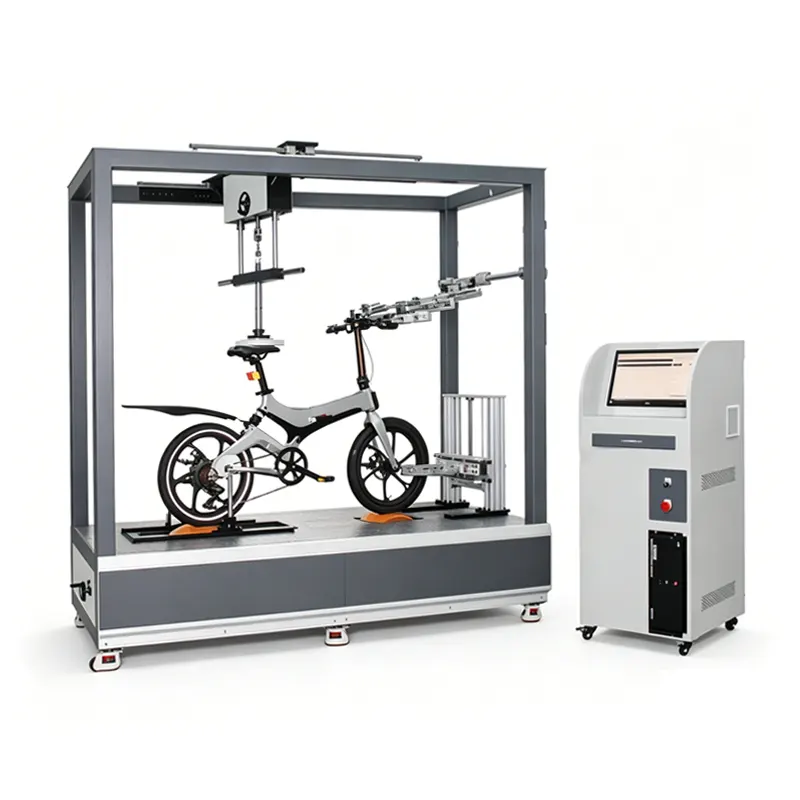
Evaluate a complete bicycle assembly under a defined laboratory programme. Derui’s simulated cycling test bench brings the bicycle installation, sample restraints and control system into one test setup. Discuss your bicycle geometry, loading method and required records before selecting the drive, fixtures and measurement configuration.
Does your project require repeated pedalling, a wheel-driven endurance run or mechanical loading at selected bicycle interfaces? These tasks need different drive arrangements and fixtures. Share your procedure so the proposed bench can be matched to the actual test.
A Laboratory Setup for Complete-Bicycle Evaluation
A complete-bicycle test keeps the selected assembly together while it is installed and operated under the conditions defined for the test. This can help a manufacturer or laboratory examine how interfaces behave together, compare assembly revisions and investigate a repeatable problem.
The usefulness of the result depends on the installation. Wheel support, crank connection and any restraint near the frame or rear assembly can change the load path. Agree on those interfaces before comparing equipment quotations, especially when moving between bicycle sizes or frame designs.
Development comparisons
Compare defined assembly revisions using the same specimen preparation, installation and operating programme.
Assembly checks
Plan observations of connections, adjustment changes or damage at agreed intervals during the run.
Repeatable investigation
Define the operating condition you want to reproduce and the evidence needed to investigate a reported issue.
Specify whether you are testing a conventional bicycle or an electrically assisted model. Battery mass, cables, drive-unit interfaces and powered operation can change the required setup; electrical functions must be included explicitly in the equipment scope.
Choose the Correct Bicycle Test Bench
“Cycling simulation” can describe several different tasks. Use the required result to choose the equipment family, then confirm which functions belong in your proposed configuration.
| Your test objective | Equipment arrangement to review | Important distinction |
|---|---|---|
| Run a complete bicycle through a specified cycling programme | Complete-bicycle mounting, drive connection, restraints and required loading. | Define what turns, what is loaded and what remains restrained. |
| Apply repeated forces to a frame | Dedicated frame fixtures and actuators with the required force direction and sequence. | A rotating crank alone does not establish a frame pedalling-force fatigue test. |
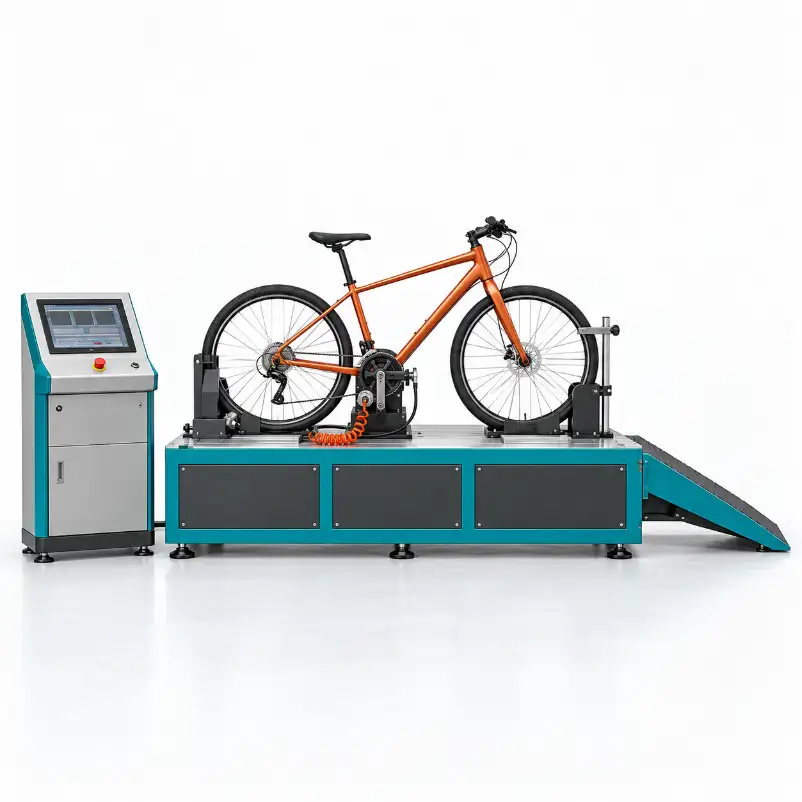
| Apply road-contact disturbances through the wheels | A defined wheel-support or drum arrangement with the specified contact features. | Confirm the actual contact geometry; do not infer obstacle simulation from a platform photograph. |
| Measure assistance, drivetrain power or electrical behaviour | Suitable loading, torque/speed or electrical measurement and the relevant control functions. | Mechanical endurance equipment does not automatically include range, battery-safety or EMC testing. |
For a broader overview, see bicycle test bench types. If your method isolates a frame, review the bicycle frame vertical fatigue testing machine instead of assuming that an assembled-bicycle run replaces that test.
Simulated Cycling Test Bench Configuration
Confirm the following items against your specimen and test procedure. This is a configuration checklist, not a table of verified model ratings. Numerical capacities and included functions should appear in the quotation for the proposed machine.
| Item | Information to provide | Configuration to confirm |
|---|---|---|
| Bicycle envelope | Wheelbase, wheel/tire size, overall dimensions and mass in the test condition. | Installation space, adjustment range and clearance for the specimen and access. |
| Sample mounting | Permitted restraint points, axle interfaces, support conditions and accessories installed. | Clamps, adapters and support locations that reproduce the required boundary conditions. |
| Drive and loading | Required drive point, direction, speed/cadence, resistance or force, and operating sequence. | Drive coupling, loading mechanism and compatible operating points. |
| Run programme | Continuous or staged operation, run duration/cycle target, pauses and inspections. | Programme steps, stop conditions and the agreed count or time basis. |
| Measurements | Required signals, units, range, accuracy needs and recording interval. | Sensors, channels, verification method and output formats included. |
| Site and access | Available utilities, floor/access conditions, installation country and handling needs. | Footprint, ramp/handling arrangement, service access and protection measures. |
Why wheelbase alone is not enough
Two bicycles with the same wheelbase may have different tire sections, crank interfaces, frame shapes and cable routes. Provide photographs and drawings of the full sample range. Ask which adapters change between models and how alignment is checked after a changeover.
Compare operating conditions together
If both drive speed and resistance are specified, confirm they can be achieved together for the proposed test. Identify whether “speed” means crank cadence, wheel rotational speed or another quantity, and define what the cycle counter counts. This prevents unlike quotations from appearing equivalent.
Plan the Test Records and Acceptance Demonstration
A useful record connects the specimen identity, installation, programme and observations. Agree on the evidence you need before defining the recording system.
- Setup record: bicycle model/serial number, installed components, mounting positions and photographs.
- Programme record: settings, sequence, intended duration or cycle target, and inspection intervals.
- Run record: available measured signals, elapsed time/count, pauses, alarms and the reason for stopping.
- Inspection record: observations, adjustment changes and damage, recorded using the procedure agreed by your laboratory.
Review a sample output for the quoted software. A display showing a running signal is not proof that raw data can be exported. If force, torque, temperature or other channels are needed, specify them individually; do not assume they are included.
Agree on a representative factory trial
Define the bicycle or substitute, mounting check, operating points and records to be demonstrated. Confirm the acceptance criteria, manuals, training, calibration/verification documents, warranty and installation responsibilities in the supply agreement. These details make the equipment easier to evaluate before shipment.
Standards and Test Scope
ISO 4210-2:2023 defines requirements for specified bicycle categories. ISO 4210-3:2023 covers common test methods, while ISO 4210-6:2023 covers frame and fork test methods. The applicable part and clause depend on the test objective.
Send the method, edition and acceptance criteria you need to use. The proposed machine configuration must be reviewed against those requirements; the product name alone does not establish full ISO 4210 compliance. For an EPAC project, identify the mechanical and electrical tasks in your EN 15194 programme separately. A mechanical cycling test does not replace the full assessment of the bicycle.
Use the method’s defined loads, cycles and inspection criteria. There is no single cycle count that proves every bicycle, component and riding application has passed, and a laboratory run should not be translated into years of road service without a validated correlation.
Get a Configuration Review for Your Bicycle
You can start with a sample photograph and your test objective if the full specification is still being prepared. For a more complete proposal, send:
- The sample: bicycle type, dimensions, mass, axle/crank interfaces and the range of models to be installed.
- The task: test procedure or relevant clauses, intended drive and loading arrangement, sequence and acceptance criteria.
- The operating conditions: required speed/cadence, force/resistance, run time or cycles, and inspection intervals.
- The evidence: measured quantities, recording/export needs and calibration or verification documentation.
- The project: installation location, utilities, project stage, timing and required installation/training scope.
“We need to evaluate [bicycle type/assembly] using [method or objective]. The sample dimensions and interfaces are [details]. We require [drive/loading programme] and [measurements/records]. Please identify the proposed configuration, included fixtures and any information still needed.”
The custom test machine RFQ checklist can help your team collect the remaining information.
Questions Before Buying a Cycling Simulation Test Bench
Can it accept both conventional bicycles and e-bikes?
Compatibility depends on the complete sample envelope, mass, mounting and drive interfaces. An e-bike also introduces requirements for powered operation and electrical measurement. Send the details of both sample types so the proposed scope can be checked.
Can we use one setup for several bicycle sizes?
Ask for the adjustment range and adapter requirements for the actual bicycle list. Include the smallest and largest samples and any unusual frame, axle or crank interfaces. A representative changeover can be included in the acceptance demonstration.
Does the bench simulate outdoor riding exactly?
A laboratory programme reproduces selected operating conditions. It can support controlled comparisons, but equivalence to a particular road route or service life requires evidence of that relationship.
Does one machine cover all ISO 4210 tests?
No blanket coverage should be assumed. Identify the required clauses, specimens and loading methods, then confirm which tests the quoted configuration can perform and which need separate equipment.
What determines the price?
The specimen range, drive/loading arrangement, tooling, sensors, controls, data outputs and acceptance/support scope determine the proposal. Send those inputs to obtain comparable quotations rather than relying only on a machine name.